

“I would be hard-pressed to describe broad financial conditions as restrictive”- Kevin Warsh, Jackson Hole.
Markets perceived yesterday’s Warsh speech as hawkish, as he explicitly stated that the Fed’s focus should be predominantly on “prices” while the labour market remains consistent with “full employment”.
Furthermore, Warsh made clear that short-term interest rates remain the primary tool to achieve the dual mandate (and not any other measures: balance sheet tightening)
“Short-term interest rates are the predominant tool to achieve the dual mandate. Unconventional policies to spur economic activity may suit genuine crises but should otherwise be used sparingly, if at all.”
Nonetheless, he retained his stance on Fed communication (and the end of forward guidance), which we believe is one reason the long end refuses to move down (rise in term premia).
But, as with other legacies of crises past, I believe that the practice has overstayed its welcome.
The following functionalities have been introduced in the past two months:
US Macro Dashboard.
US Custom Equity Sentiment Index.
US Equity Markets Rotation Leaderboard.
Global Cross-Asset Vol Dashboard.
China and Japan Macro Dashboard.
Much more is in the pipeline to make life easier for investors and traders.
We are undergoing a generational shift in how our markets operate, and a prime example was yesterday’s opening remarks by Warsh, where “hike” was deliberately used to confuse the algos.
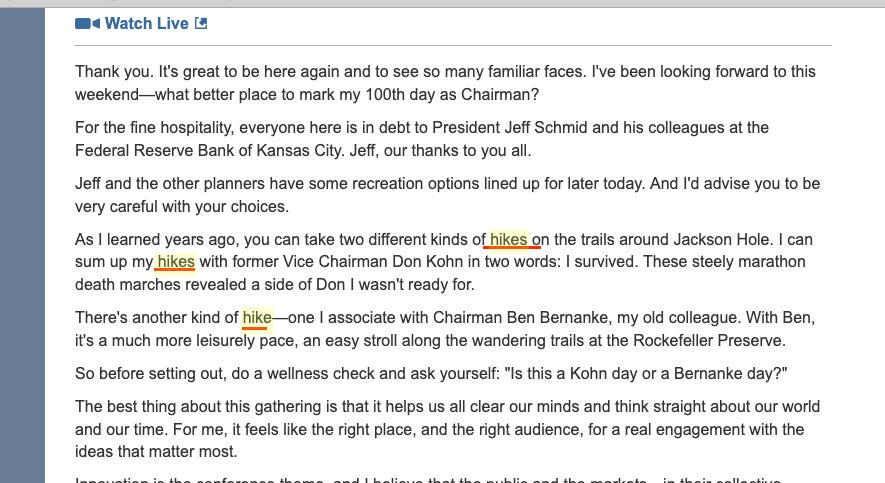
We are witnessing historical correlation breaking in real-time and markets adjusting to new narratives at a very fast pace, with “extreme” leverage leading to “overstretched” technicals.
Thus, to survive and generate alpha, we will have to evolve accordingly.
Our prime target remains to manage risk, and as a result we have beaten the benchmark in the past almost 4 years on all measures.
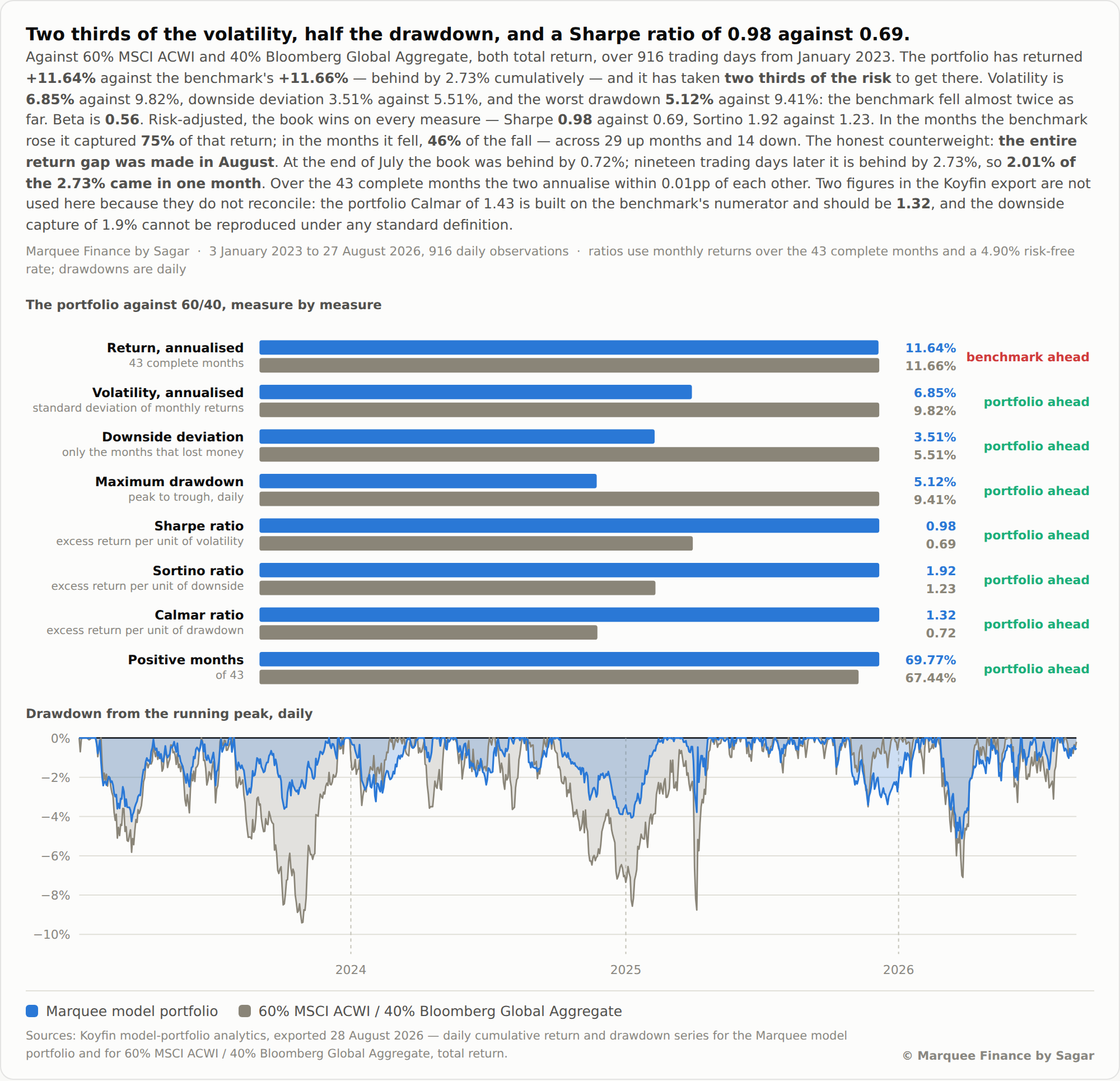
Let us begin today’s newsletter!
Global Macro!
“The responsibility for 65 months of sustained, elevated inflation sits squarely with the central bank. And that is where it belongs.”- Warsh, Jackson Hole, 2026.
The bitter truth is that the Fed has been unable to fulfil its 2% inflation mandate for the past 65 months.
While one can blame persistent supply chain disruptions from black swan events, one can’t ignore that the Fed has been behind the curve.
Fed’s preferred inflation gauge, the PCE, came in at 3.7% YoY with core PCE at 3.3%.
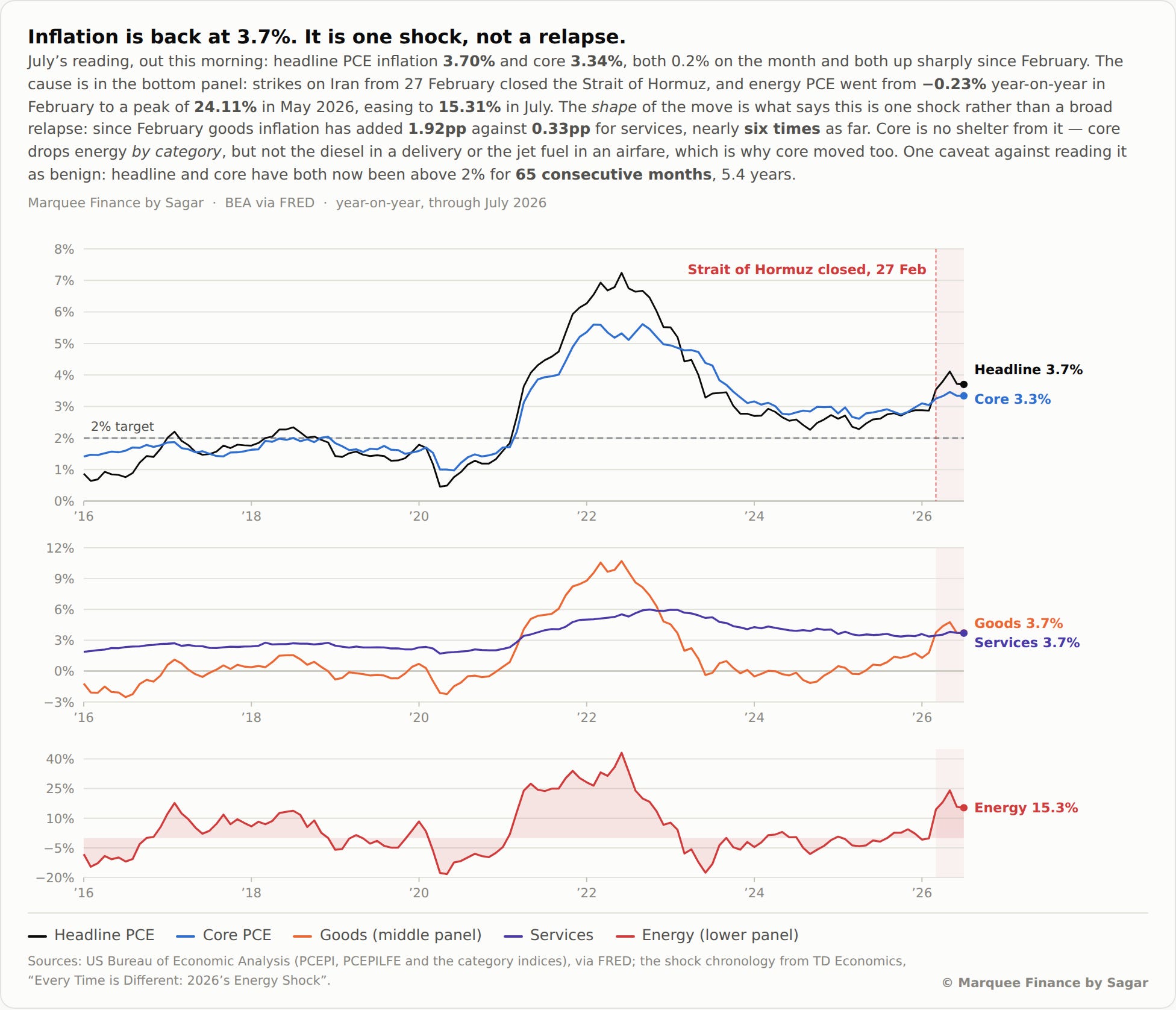
Services PCE has been sticky (3.7% YoY), while the headline PCE is driven by higher energy prices.
Both Acyclical and cyclical PCE are now running at 3.3%+ YoY levels, indicating that inflation is broadening out across the spectrum.
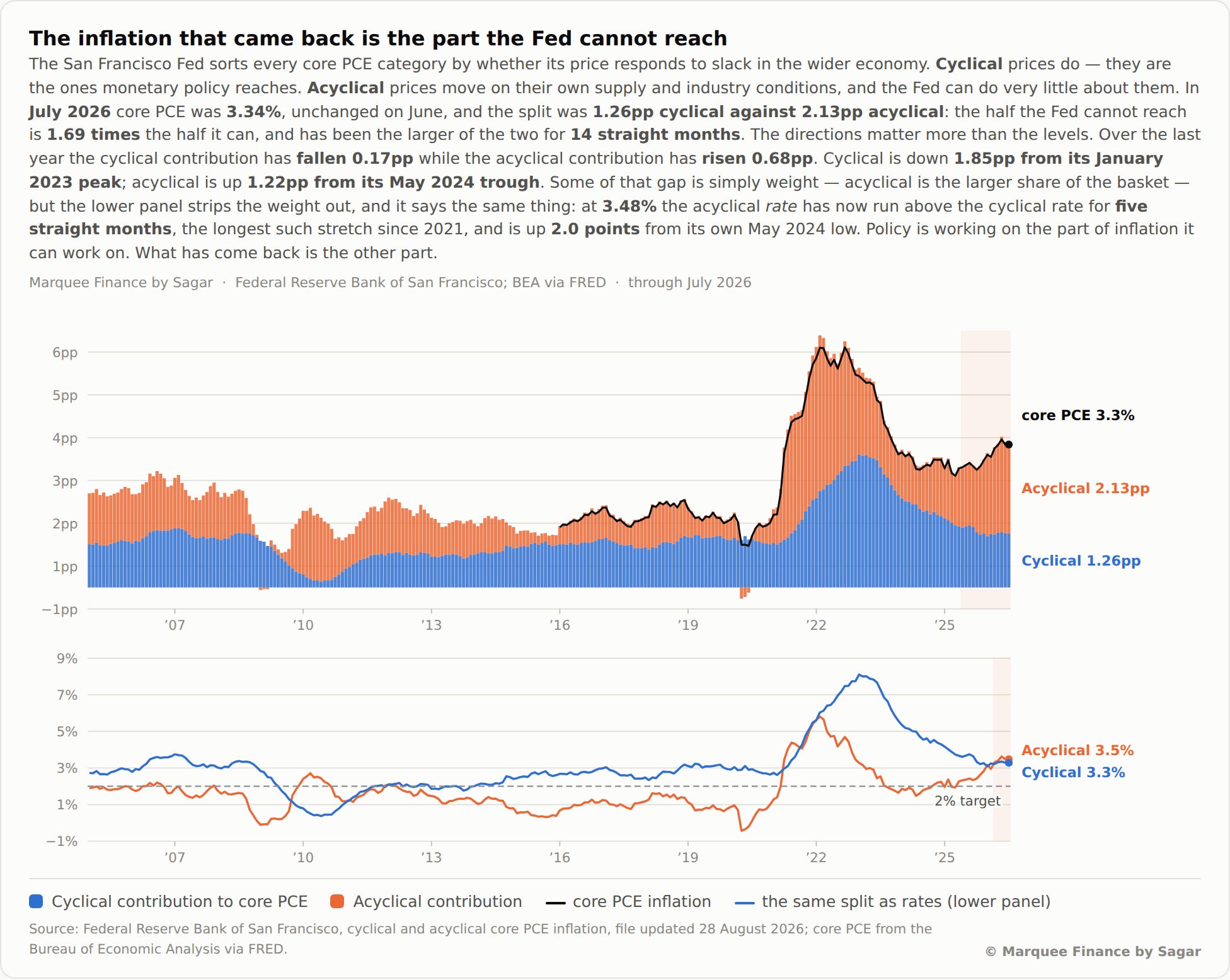
We believe that if the Fed fails to act soon, we might see inflation expectations spiral out of control, resulting in a similar mistake to what JayPo made during the 2021 transitory episode.
Despite a 6%+ fiscal deficit, the US GDP grew by 1.5% annualised in Q2.
This is a shocking outcome, and one can conclude that if the government stops spending like a drunken sailor, US growth will collapse.
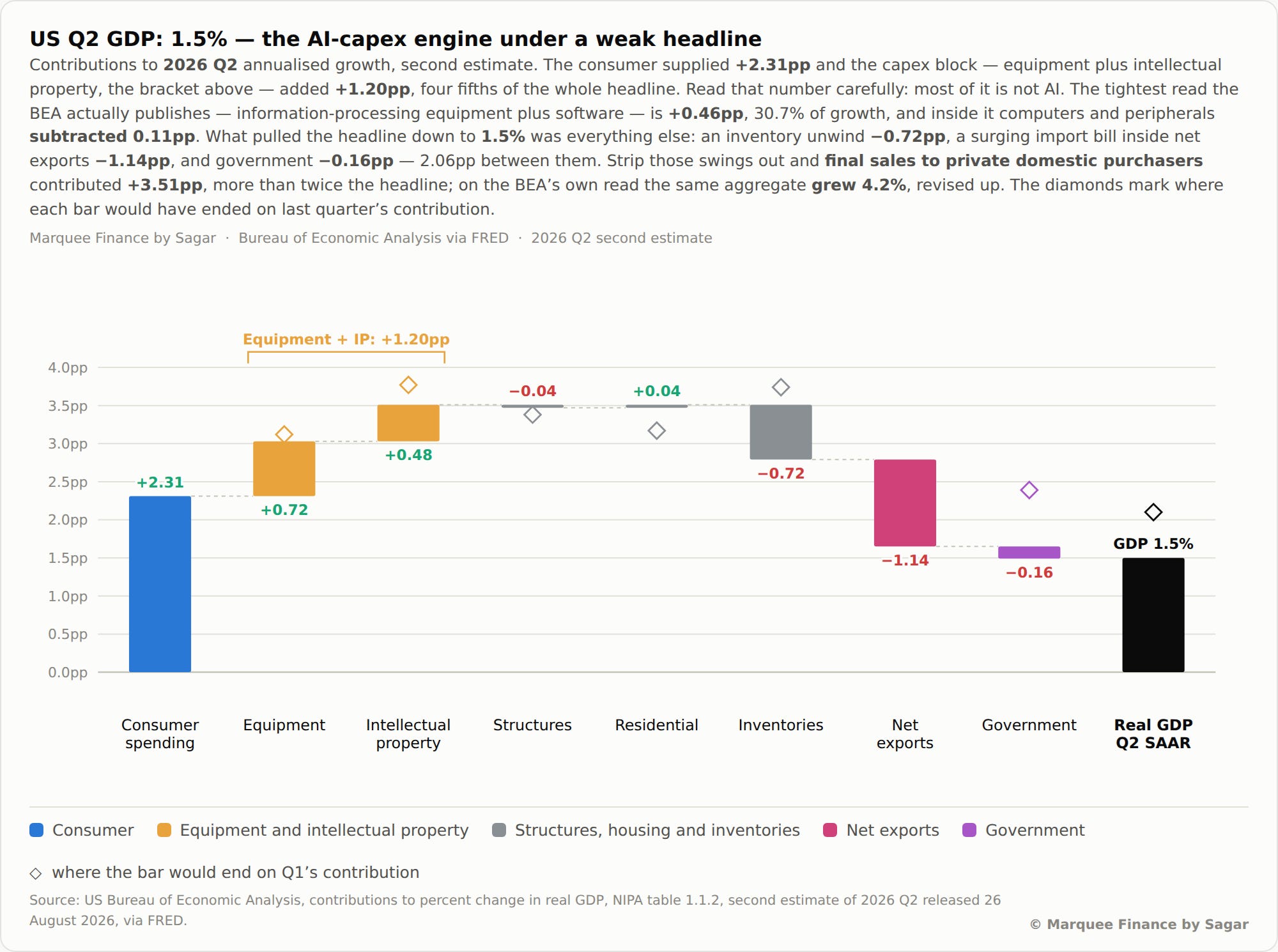
Furthermore, net exports were a major drag.
Core capital goods orders rose 0.2% MoM and 12.9% YoY.
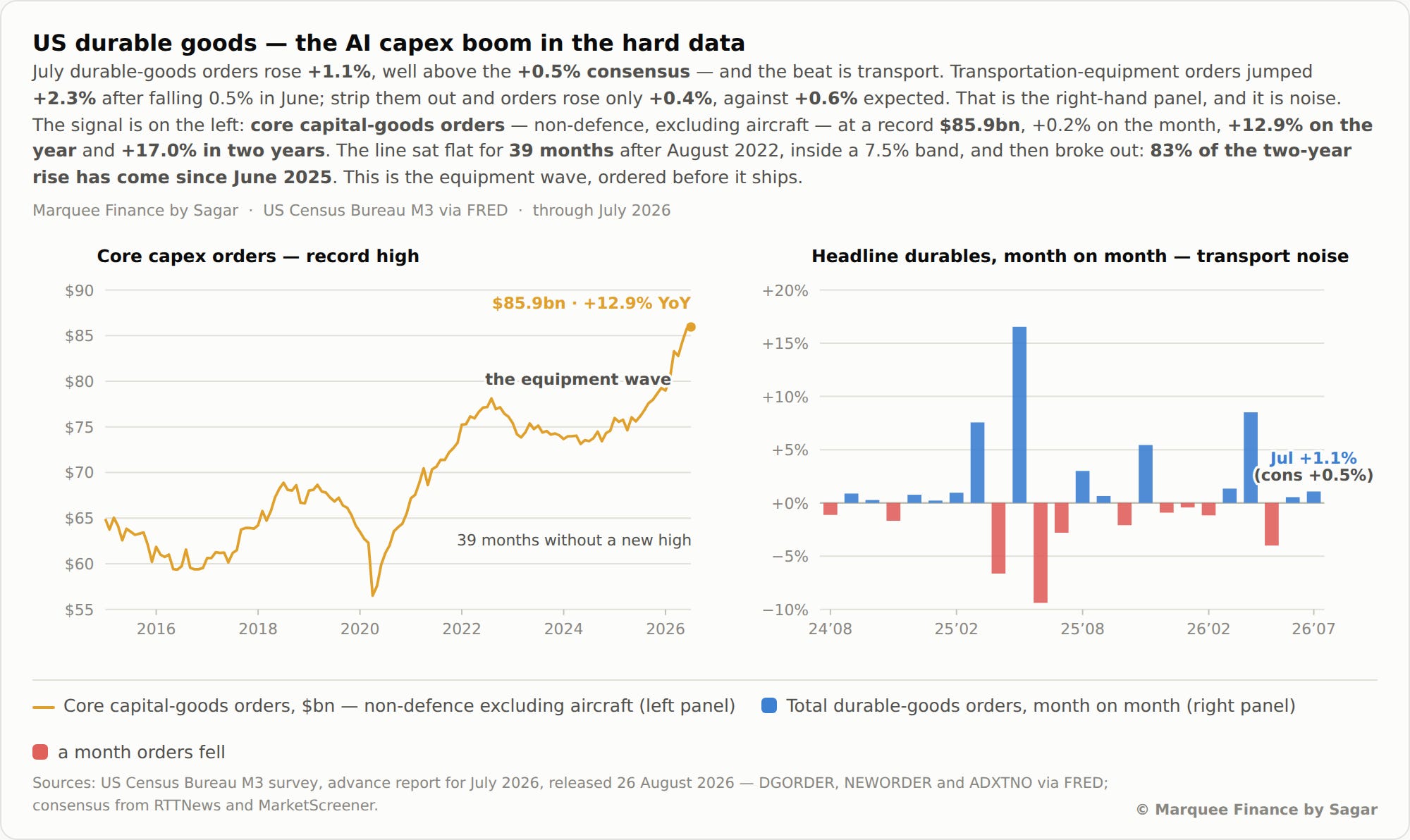
Thanks to the gigantic AI capex, core capex orders continue to print at ATH levels of $86 billion (rounded).
German IFO export expectations jumped the most since 2020 (-2.8 to 9.6 in August); however, the business climate is still under 90.
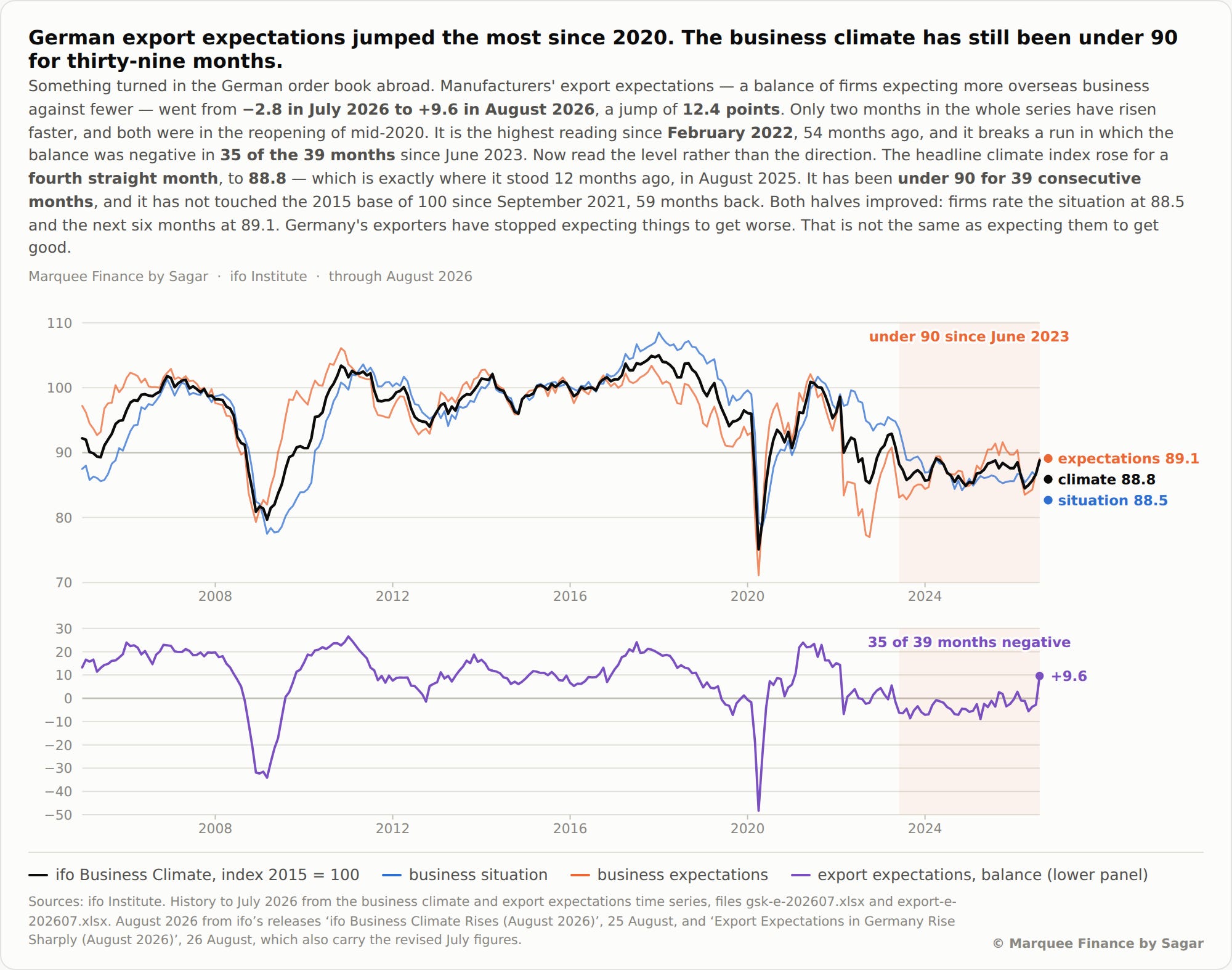
We have been indicating that a swift recovery is underway in Germany, and the soft data supports the same.
We will now wait for the hard data to validate our thesis.
In Japan, core-core is the measure that excludes both food and energy.
Tokyo CPI came in at 2% yoY in August, with Core-Core at 2% YoY as well.
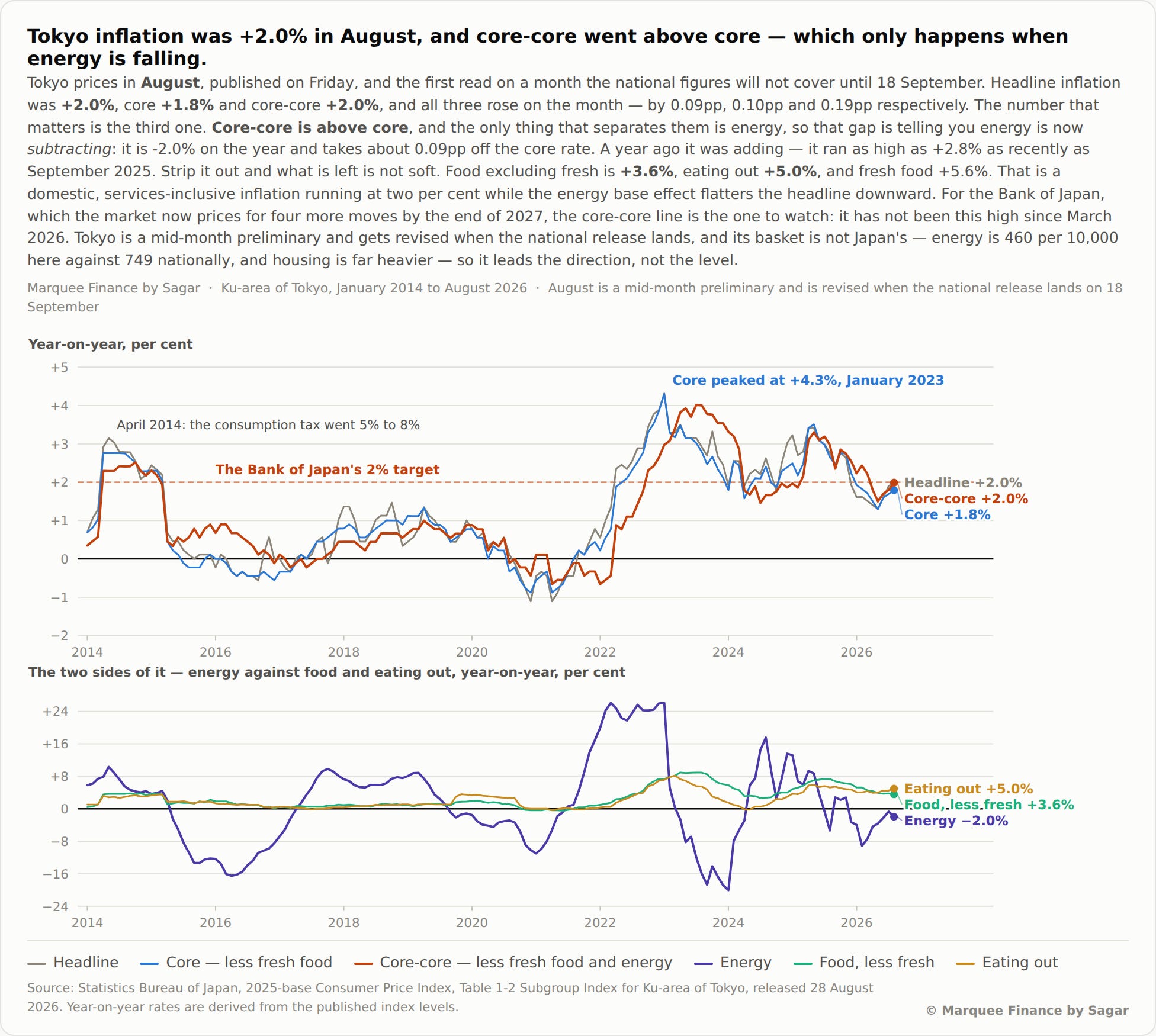
Post Tokyo CPI, markets are now pricing in a rate hike by the BoJ.
Equities!
First, the custom greed and fear index: